
Back in town,* and a whole lotta book stuff happening on these interwebs.
First up, exciting news: Ten Cents a Dance is the featured book at Books on the House for Kids & Teens! The founder of BotH, Misa Ramirez, is an author herself, and she was looking for ways to bring authors and readers together. The answer is her website: Books on the House, and Books on the House for Kids/Teens. Every week, readers can visit the sites and enter to win free signed books. Win-win for everyone!
Four reasons to trot on over and check it out:
--This is your absolutely, positively, last chance to win a signed paperback of Ten Cents a Dance (that I know of)! So throw your hat in the ring, already!
--You can see a video interview, done specially for BotH, in which I talk about why I started writing; my mother's horror when she realized I was going to make public a family secret that had been under wraps for three generations; and my current novel-in-progress (never before discussed anywhere!) Also, I make funny faces when I talk. Not helped by the fact I'm trying to look at the camera, not my computer screen, because I didn't realize they should both be in your line of vision. (I was mostly concerned with making sure that the cat litter behind me wasn't visible. Which, BTW, thank you Miss Molly Brown, for NOT peeing in the box until thirty seconds after the interview was over.)
--You can also see the Ten Cents a Dance book trailer. Didn't know there was one? Neither did I, until last week when Google Alerts tipped me off. The trailer was done by Adriana, a teen librarian in California. This is one of the most astonishing things about being published...that people will read your book and be inspired by it to create something completely new.
--Seriously, you need a fourth reason? BOOK TRAILER. CONTEST. FUNNY FACES. Ye gods, people.
*The wedding was gorgeous, BTW...sunshine, ocean breezes and rose petals, the bride and groom crazy in love, and yes, this auntie did shed tears. Bellissima!
Monday, June 28, 2010


Thursday, June 24, 2010
The Quest

To some people, shopping for a dress is the most perfect possible way to spend an afternoon.
I am not one of those people.
However, several undeniable facts have been staring me in the face:
Fact #1: When it comes to attending weddings, jeans just don't cut it. Not even my best boot cuts.
Fact #2: The most suitable dress I own was last worn to the wedding of the current bride's older sister. Two weddings a few years apart...aunt in exact same dress. Question: Do I want to be that aunt? Answer: No.
Fact #3: My next most suitable dress happens to be ten years old. Still cute. Still fits. But, realistically, how long can one drag out the millennium?
Fact #4: Even if one decided that the millennium could stretch one more year (a sketchy proposal at best), that means buying new shoes, since the old ones that went with said dress are now kaput.
Fact #5: As much as I dislike clothes shopping, I would almost rather pull my own head off than venture out for shoes. Oh, you 6 mediums who prance through shoe departments plucking pairs of cuteness right and left...pity the poor 10 double-narrow, who slogs from store to store, the inevitable refrain ringing in her ears: "We're sorry, that style doesn't come in your size. But we do have this" *displaying the shoe equivalent of a wart with hair growing out of it* "Would you like to try it on?"
No. No, I wouldn't.
So. Goal: Buy cute dress in a good color, suitable for a late-afternoon wedding, that goes with existing shoes and doesn't break the bank. Really, how hard could that be?
Fast-forward through 4 hours, 8 stores, and a crosstown drive chasing down a dress in a bigger size which a sales associate assured me was available at another location, and yet...was not. I am now a wee bit cranky.
May I ask the designers of America just one question? What is so difficult about providing dresses for grown-up people? Seriously. I would like to know the answer to this question. The few dresses I found that didn't make me look like I was trying to be 18 again (believe me, I'm not--been there, ain't going back), and also didn't make me look like someone's aged mother (which I also am not) invariably cost upwards of $200. Am I the only 46-year-old in America on a budget who wants something other than a thigh-high skirt in garish cheap jersey or pleated navy polka dots? I think not. Where are our dresses, o designers of America?
Bereft of answers, I found myself, at long last, wandering through Nordstrom. The budget is why I didn't go there first, but I love Nordie's, and will always love Nordie's, for one reason: they absolutely refuse to put up any Christmas decorations--not a single strand of tinsel, not the tiniest star--until the day after Thanksgiving. In a day and age when we're subjected to Rudolph and his damn red nose two weeks before Halloween, a store that hews to traditional seasons is dear to my heart.
And then there's Desiree.
Desiree saw my frustrated, worn-out self and took me in hand. I gave her all my criteria--including the one I haven't yet mentioned, which is that this hypothetical dress needs to be on a plane with me in less than 24 hours--and she ran with it. In ten minutes, I had eight dresses to choose from. In twenty minutes, I had a dress. A great dress. The dress. AND it was on sale.
Desiree, I wish you kittens and rainbows and your own personal enchanted genie who will wash your car and clean your house and cook you scrumptious dinners forever.
Now: if only I can get everything into the carry-on, so I don't have to check luggage. I know, I know...I already have the moon, must I want the stars, too?
Yes. Yes, I must. Off to pack, darlings.
Thursday, June 10, 2010
Reading for Comfort
 To everyone who stopped by and left a comment last time--thank you! I appreciated all the sweet thoughts.
One thing I've noticed, when I've got a lot going on or I've hit a rough patch, is that my reading pattern changes.
Some people eat for comfort. Me, I read for comfort. (Not that I have anything against comfort eating. In fact, best of all is a combination, with the eating portion preferably involving bacon. Or cheese popcorn.)
I'm much less likely to start new novels, even if they're by authors I know. Instead, I go to my shelves and pick down old favorites. These are novels I've read anywhere between five times and, I don't know, maybe twenty. Some are books I first read when I was a teen. As far as genre, they're all over the map, but they have one thing in common: From the first page, I feel like I've slipped into a sweet, familiar place.
In the past couple of weeks, I've reread The Mists of Avalon by Marion Zimmer Bradley, The Handmaid's Tale by Margaret Atwood, Spring Moon by Bette Bao Lord, and I'm just finishing Dragon Seed by Pearl S. Buck.
After that, I think I'll be ready to dive into new waters again. The Girl With the Dragon Tattoo is already on my nightstand, waiting.
How about you? Any favorite comfort reads? Or, when you have a lot on your plate, do you prefer to plunge into something brand-new?
Wednesday, May 26, 2010
To Ginny

You were six months old and you'd already had three homes.
Your first people didn't want you; their son's girlfriend brought you one day and never took you back. They kept you tied you to the porch. The only time they untied you was to bring you to the humane society. They'd had you for months, but they couldn't tell the staff whether you liked cats, kids, or other dogs. Unwanted, that's all they knew.
Your second family gave up on you after only a few days. We don't know why. But when they brought you back (an adoption failure!), that's when my sweetie met you. He described how cute you were and how you'd snuggled and pressed your head against his shoulder and gazed up at him with brown puppy eyes. (Twisted around your little paw, right from the start.)
We went to get you. But you were gone, adopted once more. So disappointed! But we were happy for you and wished you a glad doggy life.
Three days later, we visited the humane society again.
And there you were.
A second-time failure. You'd jumped on the third family's little girl. It turned out you adored kids. But you didn't know not to jump. Of course not, you'd had no socialization, no training, hardly any human interaction at all. But no excuses! Back to the humane society you went.
I knelt to say hi. You pressed your head against my shoulder and gazed up with brown puppy eyes and your funny little underbite. An hour later, you were in our car headed home.
Home to stay.
The name you came with was Mamacita. You didn't answer to it. We renamed you Ginny. Virginia Pearl, for formal occasions.
You couldn't stand to be left alone. You weren't housebroken. Every time we fed you, you frantically leaped and knocked the food bowl out of our hands, as if you didn't trust we'd actually set it on the ground. You had no idea how to play with our other dog or the dogs at the park. Let's just say you had issues.
But you wanted to please so badly. In a few days you were housebroken and you sat politely for your meals and you'd figured out a chase-me game with Jerry, our elderly German Shepherd, and you'd learned not to chase the cats.
But for the rest of your life, you couldn't stand to be alone. Well, who would, if they'd been left tied to a porch and ignored? So when dear Jerry passed on, we brought home Inja. And with your new best friend, you discovered the world.

Running in the snow on Christmas Day...

...and in Utah on vacation...

...and when you were tired, turnabout's fair play when it came to being a pillow.
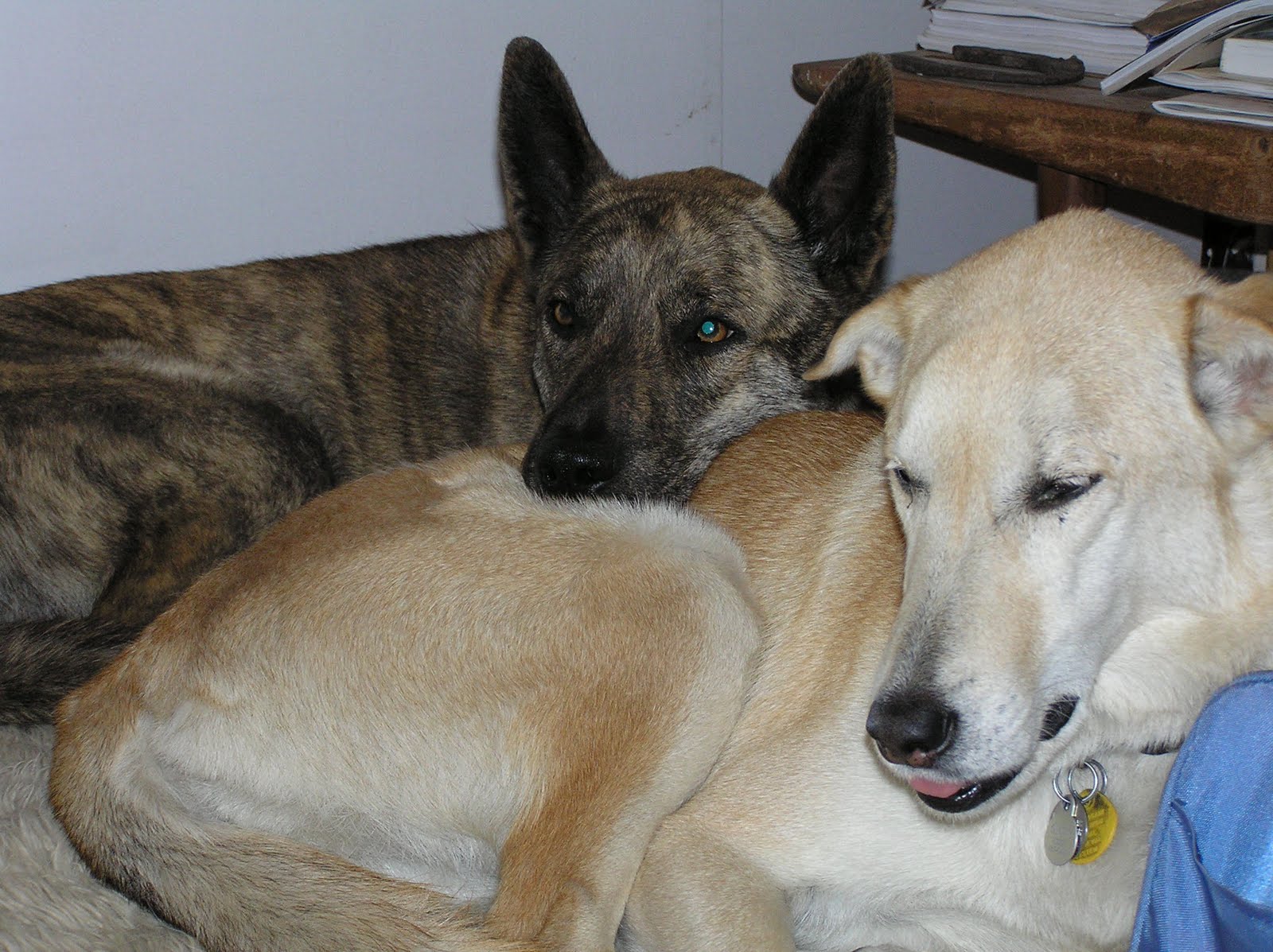
You patiently kept me company while I wrote my first novel...
 ...and my second...
 ...and my third.
Being in the water was the only time the Labrador part of you ever kicked in. On dry land, your idea of "retrieving" was: The Toy is MINE If You Want It You Have to Chase Me But You'll Never Get It HA HA HA!


Your very favorite thing was to flaunt your toy-of-the-moment, lay it delicately on our knees or drop it on poor Inja's head, then snatch it back and run away laughing.
 When we babysat Fergus the Sheltie puppy, you wanted his favorite fleece toy so badly you practically bled out your eyes. All other subterfuges having failed, you suddenly ran to the window barking. The moment Fergus jumped up to see what was out there, you swiped the toy and snuck off with it. Like stealing candy from a baby.
 But when baby Molly got a trouncing from her big cat brother Albert, you hurried over to see if she needed saving. If we were upset, or unhappy, or sad, you'd press your sweet head against our shoulders and gaze up with anxious brown eyes, and if we needed to hug you, you'd let yourself be hugged forever.
When you were six years old, you got sick. That's when we discovered your liver cirrhosis. (Hadn't we told you to lay off those margaritas?!) Oh, and you had congenital kidney disease, too. Double whammy. The liver disease alone gave you a life expectancy of six months.
But you pulled through that episode. And another one. And a few more. But surely you were a bedridden invalid?

Ha! That's you at eleven. (Photo by your friends Kim and James at Stay Pet Hotel.) We began joking that you would never die, because then Inja would get all your toys. I half-hoped it was true.
It wasn't. You'd just turned twelve. Almost six years late, but it finally came.
Six extra wonderful years. I know we shouldn't have hoped for more. But we did.
Your ears stuck out to the sides and when you trotted, their tips bounced up and down in a way that made random strangers laugh. When you were sleepy, or you really, really, really wanted something (like begging to get on the couch..."But look, you've got sooooo much room up there!!") your underbite showed.
You were adorable. You were smart. Your sense of humor was better than some humans' I know. We count ourselves the luckiest people in the world to have had you.
Grieve not, nor speak of me with tears
But laugh and talk of me as if I were beside you
I loved you so...
...`Twas heaven here with you.
But laugh and talk of me as if I were beside you
I loved you so...
...`Twas heaven here with you.
--Isla Paschal Richardson
 We love you, sweet Ginny. We miss you.
Goodbye.
Monday, May 17, 2010
GetGlue on a Monday
In the Good News and Heads Up, Y'all departments: GetGlue is featuring Ten Cents a Dance as part of their Monday giveaway!
For a shot at winning a copy, head on over. Good luck!
For a shot at winning a copy, head on over. Good luck!
Wednesday, May 12, 2010
F-Bombs Away!
 Blogger mi over at i know, write?!? has posted a great piece discussing the issue of cursing in YA fiction. On the one hand, it's realistic for our characters; a lot of teens do curse, after all. On the other hand, do we want teens thinking that by writing about it, we condone swearing...or drugs, or sex, or whatever undesirable behavior our characters engage in?
mi's post got me thinking. I started writing a comment, but I soon realized it was going to be such a long comment, it might be better as its own blog.
When it comes to writing, I'm a realism gal. I don't like sugar-coating things or glossing over them. I believe if we're going to write, we ought to write as truthfully as we can. I guess that comes across in my own work; reviews have called my novels authentic, gritty, even hard-boiled. (I hope that last one was a compliment; when it comes to reviews, oddly enough, sometimes it's hard to tell.)
But as much as I love realism, it doesn't reign supreme. What does? Story. The story is king; the story trumps all.
When I was writing my first novel, I knew my main character, Tallulah, was rebellious and short-tempered and just generally difficult. I wrote her voice the way I heard it in my head, and the F-bombs dropped at an alarming rate. Later, people who read the manuscript told me it was like getting smacked in the face every other page. When I went back and read the manuscript, to my surprise, it was like getting smacked in the face. It was hard to see past the cussing to the character underneath.
In fact, I realized, I didn't have much of a character underneath. That's when I learned that realism isn't the same thing as transcription. I was using the swearing to convey that Tallulah was a tough girl. But instead it made her seem more like an unpleasant caricature than a flesh-and-blood person. And it wasn't helping the story; in fact, it bogged the story down.
So I dropped the profanities. (Most of them, anyway. At one point, Tallulah gets struck in the chest by a horse; having had the same experience myself, I can vouch that this is one instance that absolutely justifies swearing...just as soon as you manage to suck the breath back into your lungs.) But getting rid of the swearing, I discovered, left me with enormous character holes to fill. I had to go back and figure out how to get across Tallulah's tough-chick attitude with inflections and tones, body language and action. More importantly for the character, and the story: I had to figure out what she was really feeling...and why.
Once I did that, Tallulah took on dimensions and shape. She became real. And as she took on more depth and complexity, so did her story. I realized I'd been using the swearing as a shortcut, as if to say, "See? See how rebellious she is?" But I hadn't actually shown it.
Some years later, I was listening to an interview of a punk rock band. (Don't remember who, unfortunately--I'm terrible with names.) Anyway, the two guys who wrote the songs talked about how one night they were brainstorming lyrics, and one of them wrote, "F*** this s***," and they were both like, "Yeah, dude! F*** this s***!" and then one of them turned to the other and said, "So like, what s*** are we talking about, specifically?" And they realized they had no idea. So they thought about it, and they began writing about what they felt was wrong in the world, and why, and how it made them feel, and how it might change. That, they said, was the turning point, when the band took off. I can't for the life of me remember who those guys are, but I've never forgotten that story, because it's absolutely true: if you say "F*** that s***," you ought to at least be clear on what s*** it is you'd like to get f*****.
All this rambling isn't to say that there's no place for swearing in YA fiction. I believe there is, depending on the character, depending on the story. In fact, there's some in my current WiP. (Gasp!) Bottom line, the way I see it--Story is All. If it adds to the story, through rich characterization or meaningful conflict or other fabulous story-building s***, have at it. If it detracts--or if it's serving as a placeholder for something the author hasn't figured out yet--take the axe to it and dig deeper. Same goes for everything our characters say and do. If it doesn't serve the story, it's gone.
One other thing about cussing (and other disreputable goings-on) in YA. If there's swearing in adult books, nobody cares. If there's swearing in YA novels, lots of people care. People like librarians, teachers, and parents. (Just take a gander at this list of books banned in 2009. The first thing I noticed: Damn, that's a long list. The second thing: "profanity" or "vulgar language" is one of the most-cited reasons for banning.) So, could it be an issue? Like all else in publishing: Maybe. Depends. (Another thing to notice about that banned-books list: How many award-winners and literary classics are on it. Being banned isn't like being shunned when you're Amish. Lots of people will still come out to play with you.) Agents and editors can, and probably will, weigh in with their advice. Still, in the end, it's up to the author to decide how best to tell his or her story.
Story is All. Story is King. Long live Story.
(Thank you, mi, for writing such a thought-provoking post!)
Thursday, April 29, 2010
Discovering Marilyn
One recent evening I was browsing Netflix, waiting for my sweetheart to come home, and I came across Gentlemen Prefer Blondes. I remembered seeing bits of it on TV when I was little, although the only part I remembered clearly was when Marilyn Monroe's character, Lorelei Lee, meets the owner of a diamond mine and fantasizes a big old diamond where his head would be. I must have found that pretty funny when I was a kid, because that's all that stuck with me, other than a general impression of silliness.
I'd just finished a long and sort of bruising day at the day job. I was in the mood for silly. I zapped it to my TV and settled back. And from the opening number--"Two Little Girls from Little Rock"--I was in a state of wow.
This isn't a movie review, because I unabashedly adore this movie. Yes, the male stars are completely forgettable. Yes, the plot is entirely predictable--its main concern being the number of skin-tight outfits it can smoosh our heroines into. (Marilyn's co-star is Jane Russell, the actress for whom Howard Hughes engineered a new kind of underwire bra to achieve the exact right cleavage for his movie The Outlaw.) Yes, it has dialogue like this:
Anonymous Male Character 1: (gesturing at Marilyn and Jane)"If this ship sinks, which one would you save?"
Anonymous Male Character 2: "Those girls couldn't drown!"
And yes, Marilyn does get stuck climbing through a porthole.
It's that kind of movie. Dumb. Cynical. (Have you ever really listened to the lyrics of "Diamonds Are a Girl's Best Friend"?) And silly beyond all belief.
And yet. Love, love, love. Jane Russell is at her wisecracking best. Marilyn's Lorelei Lee is absolute perfection. If it's true that it takes a smart actor to play a dumb character, Marilyn must have been a freaking genius.
Before this, I've never seen an entire Marilyn Monroe movie. For some reason, I had the impression that mostly she stood around and looked...well, like Marilyn. Before this, whenever I thought about Marilyn Monroe, I mostly thought about drugs and Kennedys and tragic death. But when she launched into...
"A kiss on the hand may be quite continental..."
...I literally got goosebumps. There's a reason that performance is iconic, and it's not because of the dress, or the platinum hair, but because Marilyn was just insanely talented.
I realize everyone else in the world is probably already aware of this. I'm embarrassed to admit it was a revelation to me.
I'm a newfound Marilyn fan. And if you see me driving around, singing in my car, it'll either be "Two Little Girls From Little Rock" or "Ain't Anyone Here for Love" (which, BTW, if you thought beefcake was a recent invention, think again), or "Bye Bye Baby," or the queen of them all, "Diamonds."
Every last cynical, scintillating syllable of it.
I'd just finished a long and sort of bruising day at the day job. I was in the mood for silly. I zapped it to my TV and settled back. And from the opening number--"Two Little Girls from Little Rock"--I was in a state of wow.
This isn't a movie review, because I unabashedly adore this movie. Yes, the male stars are completely forgettable. Yes, the plot is entirely predictable--its main concern being the number of skin-tight outfits it can smoosh our heroines into. (Marilyn's co-star is Jane Russell, the actress for whom Howard Hughes engineered a new kind of underwire bra to achieve the exact right cleavage for his movie The Outlaw.) Yes, it has dialogue like this:
Anonymous Male Character 1: (gesturing at Marilyn and Jane)"If this ship sinks, which one would you save?"
Anonymous Male Character 2: "Those girls couldn't drown!"
And yes, Marilyn does get stuck climbing through a porthole.
It's that kind of movie. Dumb. Cynical. (Have you ever really listened to the lyrics of "Diamonds Are a Girl's Best Friend"?) And silly beyond all belief.
And yet. Love, love, love. Jane Russell is at her wisecracking best. Marilyn's Lorelei Lee is absolute perfection. If it's true that it takes a smart actor to play a dumb character, Marilyn must have been a freaking genius.
Before this, I've never seen an entire Marilyn Monroe movie. For some reason, I had the impression that mostly she stood around and looked...well, like Marilyn. Before this, whenever I thought about Marilyn Monroe, I mostly thought about drugs and Kennedys and tragic death. But when she launched into...
"A kiss on the hand may be quite continental..."
...I literally got goosebumps. There's a reason that performance is iconic, and it's not because of the dress, or the platinum hair, but because Marilyn was just insanely talented.
I realize everyone else in the world is probably already aware of this. I'm embarrassed to admit it was a revelation to me.
I'm a newfound Marilyn fan. And if you see me driving around, singing in my car, it'll either be "Two Little Girls From Little Rock" or "Ain't Anyone Here for Love" (which, BTW, if you thought beefcake was a recent invention, think again), or "Bye Bye Baby," or the queen of them all, "Diamonds."
Every last cynical, scintillating syllable of it.
Thursday, April 08, 2010
Buy Books--Help Teens
 If you love reading--especially if you love reading fiction--you can probably point to one or more books that made a difference in your life. Maybe it's a book that introduced you to a whole new world; maybe it's a book that gave you comfort or escape when you needed it; maybe it's a book that fired your imagination.
If you love books, try to imagine what it would be like to grow up without them.
One of the cool things about the YA lit community is that it's crammed with folks who not only love books, read books, review books, and write books for teens, but who also actively work to get books into teens' hands. Guy's Lit Wire, YALSA, Readergirlz, and If I Read I Can Do Anything have teamed up for Operation Teen Book Drop 2010. One of the goals for the book drop this year: provide two Native American reservation schools with much-needed titles for their libraries.
Colleen Mondor, of the Chasing Ray blog, writes very eloquently about the schools, their needs, and details of Operation Book Drop here. I can't say anything about this topic better than she can, so I'll leave you in her capable hands. If visual is more your style, here's a video.
OR, if you're one of those spring-straight-into-action types, then jump over to Powell's Bookstore wishlist page, enter guyslitwire@gmail.com in the search box, and choose a title (or two, or three, or however many you like) from each school's wishlist. (Be sure to bookmark Colleen's blog post first, so you'll have the schools' addresses handy.)
I was lucky. I grew up in a household that could afford books and had a lot of them (almost 2,000 at one point.) My parents sent me to private schools that had small but well-stocked libraries. Books have had such a tremendous impact on my life, I can't imagine where or even who I'd be without them.
Not everyone has to be an avid reader. But everyone who wants books should have them available. If you can, help put a book in the hands of a teen.
Wednesday, April 07, 2010
Blog Contest Winner!
Thank you to everyone who stopped by to comment on Once More on the Dance Floor! I'm delighted to announce the winner, chosen by a random number generator, is jpetroroy.
The consensus definitely swung toward the new cover, although the old one got a lot of love, too. I like them both in different ways. I agree with the commenters who noted that each cover emphasizes a different aspect of the book: the new one more on the romance (although the book isn't a romance novel, there's definitely a bad-boy-love angle), and the old cover on the historical aspects. Since I'm a history buff, I must admit I lean a weency bit more toward the old cover. I just love that red fingernail polish and the pinstripe suit!
Thanks for playing, everyone, and for telling me what you think!
The consensus definitely swung toward the new cover, although the old one got a lot of love, too. I like them both in different ways. I agree with the commenters who noted that each cover emphasizes a different aspect of the book: the new one more on the romance (although the book isn't a romance novel, there's definitely a bad-boy-love angle), and the old cover on the historical aspects. Since I'm a history buff, I must admit I lean a weency bit more toward the old cover. I just love that red fingernail polish and the pinstripe suit!
Thanks for playing, everyone, and for telling me what you think!
Monday, March 29, 2010
Once More on the Dance Floor
Today is the release day of Ten Cents a Dance...in paperback, with a brand-new look!

My first reaction on seeing it? OOH, PRETTY!
This brings up a question that ikw asked in the comments on a previous post: "i was wondering why your latest novel has two different covers. do you, as the author, ever get to have any input on cover design?"
It's true that a paperback often has a different cover from the original hardback. The paperback cover is an opportunity to change the focus on the book; to attract a wider or a different audience; to help bring new attention to a title that's been out in the world a while. But whether or not to design a new cover isn't up to the author. The publisher is the one who makes that call.
As far as author input, that's also up to the publisher. Some authors get no say about their covers at all. In that regard I'm really lucky, because my editor at Bloomsbury has always asked my opinion about the cover designs for my books. (For more insight into the process, check out my previous post about the Ten Cents a Dance hardcover here.)
New edition. New cover. It's like my book is all grown up and leaving home...for the second time. And I'm the mom waving from the doorway, dabbing my eyes, calling, Have fun! Make lots of friends! Be sure to write!
(OK, maybe not that last one. But you get the idea.)
So, blog readers, what do you think? Do you prefer the old cover,* or the new? Vote in the comments by 12 AM Wednesday, April 6th, and you'll get a chance to win a copy of your choice: either hardcover or paperback! (No fear, I'll be picking the winner randomly--so be free with your opinions!)
*old cover:


My first reaction on seeing it? OOH, PRETTY!
This brings up a question that ikw asked in the comments on a previous post: "i was wondering why your latest novel has two different covers. do you, as the author, ever get to have any input on cover design?"
It's true that a paperback often has a different cover from the original hardback. The paperback cover is an opportunity to change the focus on the book; to attract a wider or a different audience; to help bring new attention to a title that's been out in the world a while. But whether or not to design a new cover isn't up to the author. The publisher is the one who makes that call.
As far as author input, that's also up to the publisher. Some authors get no say about their covers at all. In that regard I'm really lucky, because my editor at Bloomsbury has always asked my opinion about the cover designs for my books. (For more insight into the process, check out my previous post about the Ten Cents a Dance hardcover here.)
New edition. New cover. It's like my book is all grown up and leaving home...for the second time. And I'm the mom waving from the doorway, dabbing my eyes, calling, Have fun! Make lots of friends! Be sure to write!
(OK, maybe not that last one. But you get the idea.)
So, blog readers, what do you think? Do you prefer the old cover,* or the new? Vote in the comments by 12 AM Wednesday, April 6th, and you'll get a chance to win a copy of your choice: either hardcover or paperback! (No fear, I'll be picking the winner randomly--so be free with your opinions!)
*old cover:

Sunday, March 21, 2010
To Kindle, Or Not to Kindle? THAT is the Question
This year, for my birthday, I got an unexpected surprise: my friend Walter sent me an Amazon gift certificate. In the amount of a Kindle. Get yourself one, he said. Or, if you'd rather, spend it on books instead.
Cue dilemma.
I love physical books. Can't imagine life without them. Can't imagine me without them. And yet I find e-readers fascinating. Hundreds of books at one's fingertips? The ability to travel without half my luggage weighted down with paper? (Because of course I can't take just one novel. There are the two or three I'm currently reading. Plus an old favorite, in case I need a comfort read. Plus the one I always buy in the airport bookstore, because no matter how resolved I am not to buy a new book, invariably one will beckon from the shelves, cooing, "See how shiny I am. How intriguing. Come to me, and discover in my pages a new world of depths and delights," and it's not my fault that Powell's Books has an outpost in the Portland Airport, and yes I suppose I could just not go in, but then this blog would be written by a completely different person in an alternate universe and that seems, I dunno. Unlikely.)
So back to what I was saying. Fascinated. And yet torn. Because of course when you get a Kindle, you need to download books onto it. E-books. From Amazon.com. Now, I don't dislike Amazon. In fact, I harbor a kind of distant fond admiration for it, the way you do something that's all gee-whizzy and technical and really, really good at what it does, and yet is essentially soulless. (Like Avatar. But that's a whole different post.)
And yet...
...every e-book I might buy would be one less actual book bought from a real, live, independent bookstore. And I love indie bookstores. I adore the hand-written shelf cards telling me which books are staff favorites. I look forward to seeing the same people every time I go in, and getting to know them, and picking their brains for book recommendations. I love the sense of timelessness that envelops me as soon as I walk in the door. The feeling that all cares and worries belong to another world, and here, in this small place, the only important things are the stories. Best of all, though, is noticing a cover, or a title, and I've never heard of the book before or the author, but something about it catches my eye so I lift it down. Turn it over. Scan the blurbs and the back copy. Open it and read the first sentence. Sometimes I think "meh" and I move on. But sometimes that first sentence flicks over me like a noose and cinches tight and I'm thinking yes yes yes I must find out everything now please and I buy the book and take it home and immerse myself in its world and then go out and rave about it to everyone I know.
How would I have found A Suitable Boy on Amazon.com? Or Babe in Paradise? Or An Instance of the Fingerpost, or A Northern Light, or Wives and Daughters, or The Man in My Basement, or The Once and Future King? How do you stumble across a gem that's not in the top 50 in sales rankings and not by an author you've previously read and not the latest book club fad? When you don't know a book exists, how can you type its name into a search box?
You can't. Which is why you go to your local bookstore and wander the stacks to discover the next unknown book you're going to love. Which means that the bookstore has to be there, and the only way it can be there is if people keep going and buying books.
And yet...
And yet...
Back and forth. Up and down. And finally Walter was like, what are you doing, and I'm like, I dunno, dude, and I realized I just had to decide. So I did.
When the Kindle arrived, it happened that I was re-reading one of my favorites, a 1946 edition of Pavilion of Women by Pearl Buck. I'd bought it used from an indie bookstore a few years ago. The dust jacket is long gone. Some previous owner had amused herself by penciling over parts of the cover illustration. Its edges are worn and dented in places. It feels handled and much, much read, and its pages have that sweet, dusty, woody scent of old book paper. (Old book is like puppy breath--one of the great, immortal aromas of life. Whatever happened to it? I miss it.)
The Kindle isn't flashy; like the book, it doesn't draw attention to itself. I charge it, turn it on, and navigate to the Kindle store. There on the home page, practically the first thing I see: Margaret Atwood's latest, The Year of the Flood.
IwantIwantIwant. I click. Less than a minute later, the book is here in my hand. I won't lie to you: that is beyond cool. I start the first chapter, but it's hard to lose myself in the flow; I'm too aware of what I'm reading it on. But after a while, the words catch me and I go under, immersed in Margaret's world, and it's not until I finish the second chapter that I realize: the Kindle has disappeared. The same way a physical book disappears, when the story takes hold and we slip into the dream the author has created.
So here I am: a lifelong book lover, with overflowing bookcases and teetering stacks all over my house, eleven novels on my nightstand right now, a passionate believer in bookstores...and a Kindle owner. The Atwood novel is the only one I've bought. All the others I've downloaded are free. They're works in the public domain--classics--that I've already owned or already read.
If we vote with our dollars, I've decided that mine will continue to vote for bookstores.
I'm still reading two to three books at a time, but now, one of them is on the Kindle. (Current pick: Tess of the D'Ubervilles.) Every time I turn it on, the idea of reading 19th century literature on a 21st century device makes me smile. But then the words appear, everything in the real world vanishes--including the device that brings me those words--and I'm in England, on a summer evening, slipping into the dairy with Tess.
P.S...Many thanks, Walter, for the shove into the future!
Cue dilemma.
I love physical books. Can't imagine life without them. Can't imagine me without them. And yet I find e-readers fascinating. Hundreds of books at one's fingertips? The ability to travel without half my luggage weighted down with paper? (Because of course I can't take just one novel. There are the two or three I'm currently reading. Plus an old favorite, in case I need a comfort read. Plus the one I always buy in the airport bookstore, because no matter how resolved I am not to buy a new book, invariably one will beckon from the shelves, cooing, "See how shiny I am. How intriguing. Come to me, and discover in my pages a new world of depths and delights," and it's not my fault that Powell's Books has an outpost in the Portland Airport, and yes I suppose I could just not go in, but then this blog would be written by a completely different person in an alternate universe and that seems, I dunno. Unlikely.)
So back to what I was saying. Fascinated. And yet torn. Because of course when you get a Kindle, you need to download books onto it. E-books. From Amazon.com. Now, I don't dislike Amazon. In fact, I harbor a kind of distant fond admiration for it, the way you do something that's all gee-whizzy and technical and really, really good at what it does, and yet is essentially soulless. (Like Avatar. But that's a whole different post.)
And yet...
...every e-book I might buy would be one less actual book bought from a real, live, independent bookstore. And I love indie bookstores. I adore the hand-written shelf cards telling me which books are staff favorites. I look forward to seeing the same people every time I go in, and getting to know them, and picking their brains for book recommendations. I love the sense of timelessness that envelops me as soon as I walk in the door. The feeling that all cares and worries belong to another world, and here, in this small place, the only important things are the stories. Best of all, though, is noticing a cover, or a title, and I've never heard of the book before or the author, but something about it catches my eye so I lift it down. Turn it over. Scan the blurbs and the back copy. Open it and read the first sentence. Sometimes I think "meh" and I move on. But sometimes that first sentence flicks over me like a noose and cinches tight and I'm thinking yes yes yes I must find out everything now please and I buy the book and take it home and immerse myself in its world and then go out and rave about it to everyone I know.
How would I have found A Suitable Boy on Amazon.com? Or Babe in Paradise? Or An Instance of the Fingerpost, or A Northern Light, or Wives and Daughters, or The Man in My Basement, or The Once and Future King? How do you stumble across a gem that's not in the top 50 in sales rankings and not by an author you've previously read and not the latest book club fad? When you don't know a book exists, how can you type its name into a search box?
You can't. Which is why you go to your local bookstore and wander the stacks to discover the next unknown book you're going to love. Which means that the bookstore has to be there, and the only way it can be there is if people keep going and buying books.
And yet...
And yet...
Back and forth. Up and down. And finally Walter was like, what are you doing, and I'm like, I dunno, dude, and I realized I just had to decide. So I did.
When the Kindle arrived, it happened that I was re-reading one of my favorites, a 1946 edition of Pavilion of Women by Pearl Buck. I'd bought it used from an indie bookstore a few years ago. The dust jacket is long gone. Some previous owner had amused herself by penciling over parts of the cover illustration. Its edges are worn and dented in places. It feels handled and much, much read, and its pages have that sweet, dusty, woody scent of old book paper. (Old book is like puppy breath--one of the great, immortal aromas of life. Whatever happened to it? I miss it.)
The Kindle isn't flashy; like the book, it doesn't draw attention to itself. I charge it, turn it on, and navigate to the Kindle store. There on the home page, practically the first thing I see: Margaret Atwood's latest, The Year of the Flood.
IwantIwantIwant. I click. Less than a minute later, the book is here in my hand. I won't lie to you: that is beyond cool. I start the first chapter, but it's hard to lose myself in the flow; I'm too aware of what I'm reading it on. But after a while, the words catch me and I go under, immersed in Margaret's world, and it's not until I finish the second chapter that I realize: the Kindle has disappeared. The same way a physical book disappears, when the story takes hold and we slip into the dream the author has created.
So here I am: a lifelong book lover, with overflowing bookcases and teetering stacks all over my house, eleven novels on my nightstand right now, a passionate believer in bookstores...and a Kindle owner. The Atwood novel is the only one I've bought. All the others I've downloaded are free. They're works in the public domain--classics--that I've already owned or already read.
If we vote with our dollars, I've decided that mine will continue to vote for bookstores.
I'm still reading two to three books at a time, but now, one of them is on the Kindle. (Current pick: Tess of the D'Ubervilles.) Every time I turn it on, the idea of reading 19th century literature on a 21st century device makes me smile. But then the words appear, everything in the real world vanishes--including the device that brings me those words--and I'm in England, on a summer evening, slipping into the dairy with Tess.
P.S...Many thanks, Walter, for the shove into the future!
Friday, March 19, 2010
This blog has moved
This blog is now located at http://christinefletcherbooks.blogspot.com/.
You will be automatically redirected in 30 seconds, or you may click here.
For feed subscribers, please update your feed subscriptions to
http://christinefletcherbooks.blogspot.com/feeds/posts/default.
Wednesday, March 03, 2010
How to Become a Hepkitten in 5 Easy Steps
On Sunday, I had the honor of giving my Hepkitten* presentation as part of the Winter Reading and Arts Festival at Cedar Mill Community Library. A hepkitten what they called a girl who was crazy for dancing, back in the day--like the main character of my novel, Ruby. The Hepkitten talk is a blast to do, and what makes it even more fun is dressing the part.
Now, as anyone who knows me will attest, I am not a girly-girl. Makeup and I are barely acquainted, nail polish and I are strangers, and most days, my hair runs rampant. But after some practice, I've mostly got the process down. So here, for the first time ever, I present to you:
How to Become a Hepkitten in 5 Easy Steps


Step 1: Gather raw materials: big round brush, rat-tail comb, foam rollers, long & short bobby pins, setting lotion, hair spray, setting lotion, artificial flowers, freshly scrubbed face and a head of frizzy hair. Oh, wait. That last bit might just be me.
 Step 2: Make a deep side part (de rigueur for 1940s hairstyles); then gather hank o' hair for first victory roll. Use big round brush and setting lotion to get it all nice and smooth and ready to roll. In theory. Some days, my hair behaves. I love those days. Most of the time, though, the dynamic goes like this:
Me: Okay, hair, remember how we do this? Remember how much fun it is? Whoo-hoo, here we go!

Hair: Oh, yeah. That thing you make me do sometimes. I'm not doing that.
Me: You start behaving right now, or... *threatens hair with hairspray*
Hair: Now you've made me mad. You're gonna be sorry.
*Scene deleted due to graphic violence*

 Ah, victory! Big roll on the left: Done.
(Tip: If you're seriously interested in learning vintage hairstyles, search YouTube for tutorials. People have posted instructional videos for everything from finger waves to beehives.** My fave for victory rolls is here.)
 Step 3: Roll the right side. This is a smaller roll, and goes much better when you use the setting lotion instead of super-hold category-5-hurricane-proof hair spray, like I accidentally did on Sunday. (Can I help it the bottles are the same color?) Too late to wash my hair and start over, so (mild cursing deleted)...
...I remind myself that this is why God made artificial flowers.
 Step 4: For the back: If I have time, I'll set pin curls, let them dry and brush them out into '40s curls. If not, then a little setting lotion, foam rollers, sit 20 minutes, then swirl into one big uproll. Quick and easy.
Another tip: If all else fails, this is why God made snoods. Also 1940s authentic and perfect for almost any hair disaster.
 Hmm. Rolled, flowered, made up and mascara'd. Seems like I'm forgetting something, though...

Step 5: Ah, yes...that red, red lipstick. If you ain't got a red lip, you ain't 1940s. Wartime, baby--it was all about the bold.
Add a vintage suit jacket, vintage skirt, seamed stockings and high-heel oxford shoes...
...and voila! You are now a bona-fide hepkitten.
Many thanks to the Cedar Mill Community Library for hosting me, and also to the folks who came to hear me speak on a sunny Sunday afternoon. We had a great time and the audience was fab!
*Full title: A Hepkitten's Guide to the War. Oodles of vintage photos, video clips, and stories about what it was like to be a teen in the 1940s, with jitterbugging, taxi dancing, and the upheavals in homefront life brought by WWII.
**Click here to see the horror that is the making of a beehive. If I ever write a historical set in the early '60s, I am NOT doing this. Just watching makes my scalp whimper.
Now, as anyone who knows me will attest, I am not a girly-girl. Makeup and I are barely acquainted, nail polish and I are strangers, and most days, my hair runs rampant. But after some practice, I've mostly got the process down. So here, for the first time ever, I present to you:
How to Become a Hepkitten in 5 Easy Steps


Step 1: Gather raw materials: big round brush, rat-tail comb, foam rollers, long & short bobby pins, setting lotion, hair spray, setting lotion, artificial flowers, freshly scrubbed face and a head of frizzy hair. Oh, wait. That last bit might just be me.
 Step 2: Make a deep side part (de rigueur for 1940s hairstyles); then gather hank o' hair for first victory roll. Use big round brush and setting lotion to get it all nice and smooth and ready to roll. In theory. Some days, my hair behaves. I love those days. Most of the time, though, the dynamic goes like this:
Me: Okay, hair, remember how we do this? Remember how much fun it is? Whoo-hoo, here we go!

Hair: Oh, yeah. That thing you make me do sometimes. I'm not doing that.
Me: You start behaving right now, or... *threatens hair with hairspray*
Hair: Now you've made me mad. You're gonna be sorry.
*Scene deleted due to graphic violence*

 Ah, victory! Big roll on the left: Done.
(Tip: If you're seriously interested in learning vintage hairstyles, search YouTube for tutorials. People have posted instructional videos for everything from finger waves to beehives.** My fave for victory rolls is here.)
 Step 3: Roll the right side. This is a smaller roll, and goes much better when you use the setting lotion instead of super-hold category-5-hurricane-proof hair spray, like I accidentally did on Sunday. (Can I help it the bottles are the same color?) Too late to wash my hair and start over, so (mild cursing deleted)...
...I remind myself that this is why God made artificial flowers.
 Step 4: For the back: If I have time, I'll set pin curls, let them dry and brush them out into '40s curls. If not, then a little setting lotion, foam rollers, sit 20 minutes, then swirl into one big uproll. Quick and easy.
Another tip: If all else fails, this is why God made snoods. Also 1940s authentic and perfect for almost any hair disaster.
 Hmm. Rolled, flowered, made up and mascara'd. Seems like I'm forgetting something, though...
Step 5: Ah, yes...that red, red lipstick. If you ain't got a red lip, you ain't 1940s. Wartime, baby--it was all about the bold.
Add a vintage suit jacket, vintage skirt, seamed stockings and high-heel oxford shoes...
...and voila! You are now a bona-fide hepkitten.
Many thanks to the Cedar Mill Community Library for hosting me, and also to the folks who came to hear me speak on a sunny Sunday afternoon. We had a great time and the audience was fab!
*Full title: A Hepkitten's Guide to the War. Oodles of vintage photos, video clips, and stories about what it was like to be a teen in the 1940s, with jitterbugging, taxi dancing, and the upheavals in homefront life brought by WWII.
**Click here to see the horror that is the making of a beehive. If I ever write a historical set in the early '60s, I am NOT doing this. Just watching makes my scalp whimper.
Monday, February 22, 2010
The Art of Critique: Baby, Give It to Me Straight
In the fall of 1997, I got a flyer in the mail. Nothing fancy; just a single yellow sheet announcing that Portland novelist Karen Karbo was starting a weekly fiction writing workshop. If interested, please contact.
It was one of those lovely moments in life that happens when you've committed to a drastic course of action, subsequently decided you're insane, and then the exact thing you need to see it through falls smack into your lap.
See, two months earlier I'd quit my full-time job so that I could finish my first novel. I felt exactly as if I'd jumped out of a plane without a parachute. Okay, not in the I'm going to splat to my death in less than a minute kind of way, but in the gut-gnawing, have-I-just-ruined-my-life insomniac kind of way. (Same terror--just slower.) I didn't know how to write a novel. All I had were eighty manuscript pages and a vague idea of what might happen on page eighty-one.
Then the flyer arrived. On the first evening, I was one of ten writers sitting around Karen's dining room table. Over the next few years I did complete my novel, and get it published, due in no small part to what I learned there.
Karen's wasn't the first workshop or critique group I'd been in. But it's been by far the best, which is why, twelve years after that first class, I still take my place at her table. If you're looking to join or start a critique group yourself, here are a few things that you might want to consider:
Critique is specific. No wishy-washy "I really liked it" or "It didn't work for me" without reasons to back it up. Pinpointing why a piece works--or doesn't--can be surprisingly hard to do. And the higher the skill level of the writer, the harder it gets. A really good writer can hide fatal flaws under dazzling wordplay...which means it often takes a lot of thought and effort to put your finger on what exactly isn't working. But the payoff isn't just for the writer; the better your critique, the more you yourself are learning about the craft.
Critique isn't just pointing out the flaws. It's also important to acknowledge what the writer is doing well. Writers need to recognize their strengths, as well as their weaknesses. Plus, we all need to hear that our pages aren't pure crap.
Critique what's on the page. Don't impose your vision on someone else's work. In one early critique group (long before Karen's) a fellow "critter" told me that the premise of my book was all wrong and that instead, my two female characters should set aside their differences and form a friendship that would be a testament to female bonding in a society that doesn't value women's relationships. (Gee, projecting much?) Which not only missed the entire point of my book, it bore no relation to anything I'd already written.
I've also been in workshops in which the instructor's critique mostly centered around getting students to write in the same style as the instructor. A good workshop leader isn't interested in creating copycats. Instead, like Karen, she recognizes each student's individual style and works to help her students develop their own unique voices.
Work with people at your ability level or slightly higher. If you're far and away the best writer in the room, it's easy to start thinking you're God's gift to literature and that you know all there is to know about writing. You'd be wrong.
I'm not the best writer in my group; in twelve years, I never have been. These people are wicked talented, which means I'm always striving to up my game. In the same vein...
...Try to find people with similar goals and work ethic. This doesn't mean everyone in the group should be gunning to get published. But if it's important to you to keep learning and getting better at your craft, you'll save yourself frustration if you're not the only one.
Likewise, members need to pull their weight. That doesn't necessarily mean bringing in new chapters every week (although of course that's great.) Members of Karen's class have gone through long periods--months, even--with not a single page. But they still show up, week after week, and give honest, thoughtful, and insightful critique. Does that count? You bet it does. Good critique is damn hard work. In fact, the least welcome member of any crit group is the one who shows up only when she has pages. Critique is a two-way street: if you want to get, you have to give.
Keep the focus on the writing. In some groups, critiquing gradually takes a back seat to snacking and discussing each other's personal lives. When a critique group turns into social hour, its demise soon follows.
And finally, if you want to have a quality, longstanding writing workshop or critique group, there is one thing you must never, ever overlook:
Give yourselves a catchy name. Us? We're the Writers of Renown.
Damn skippy, as Karen would say.
Next time: Receiving critique (aka, You've Shredded My Precious Like Soggy Kleenex And I Think I Might Hate You Forever.) In the meantime, you writers out there: what's your dream critique group like?
It was one of those lovely moments in life that happens when you've committed to a drastic course of action, subsequently decided you're insane, and then the exact thing you need to see it through falls smack into your lap.
See, two months earlier I'd quit my full-time job so that I could finish my first novel. I felt exactly as if I'd jumped out of a plane without a parachute. Okay, not in the I'm going to splat to my death in less than a minute kind of way, but in the gut-gnawing, have-I-just-ruined-my-life insomniac kind of way. (Same terror--just slower.) I didn't know how to write a novel. All I had were eighty manuscript pages and a vague idea of what might happen on page eighty-one.
Then the flyer arrived. On the first evening, I was one of ten writers sitting around Karen's dining room table. Over the next few years I did complete my novel, and get it published, due in no small part to what I learned there.
Karen's wasn't the first workshop or critique group I'd been in. But it's been by far the best, which is why, twelve years after that first class, I still take my place at her table. If you're looking to join or start a critique group yourself, here are a few things that you might want to consider:
Critique is specific. No wishy-washy "I really liked it" or "It didn't work for me" without reasons to back it up. Pinpointing why a piece works--or doesn't--can be surprisingly hard to do. And the higher the skill level of the writer, the harder it gets. A really good writer can hide fatal flaws under dazzling wordplay...which means it often takes a lot of thought and effort to put your finger on what exactly isn't working. But the payoff isn't just for the writer; the better your critique, the more you yourself are learning about the craft.
Critique isn't just pointing out the flaws. It's also important to acknowledge what the writer is doing well. Writers need to recognize their strengths, as well as their weaknesses. Plus, we all need to hear that our pages aren't pure crap.
Critique what's on the page. Don't impose your vision on someone else's work. In one early critique group (long before Karen's) a fellow "critter" told me that the premise of my book was all wrong and that instead, my two female characters should set aside their differences and form a friendship that would be a testament to female bonding in a society that doesn't value women's relationships. (Gee, projecting much?) Which not only missed the entire point of my book, it bore no relation to anything I'd already written.
I've also been in workshops in which the instructor's critique mostly centered around getting students to write in the same style as the instructor. A good workshop leader isn't interested in creating copycats. Instead, like Karen, she recognizes each student's individual style and works to help her students develop their own unique voices.
Work with people at your ability level or slightly higher. If you're far and away the best writer in the room, it's easy to start thinking you're God's gift to literature and that you know all there is to know about writing. You'd be wrong.
I'm not the best writer in my group; in twelve years, I never have been. These people are wicked talented, which means I'm always striving to up my game. In the same vein...
...Try to find people with similar goals and work ethic. This doesn't mean everyone in the group should be gunning to get published. But if it's important to you to keep learning and getting better at your craft, you'll save yourself frustration if you're not the only one.
Likewise, members need to pull their weight. That doesn't necessarily mean bringing in new chapters every week (although of course that's great.) Members of Karen's class have gone through long periods--months, even--with not a single page. But they still show up, week after week, and give honest, thoughtful, and insightful critique. Does that count? You bet it does. Good critique is damn hard work. In fact, the least welcome member of any crit group is the one who shows up only when she has pages. Critique is a two-way street: if you want to get, you have to give.
Keep the focus on the writing. In some groups, critiquing gradually takes a back seat to snacking and discussing each other's personal lives. When a critique group turns into social hour, its demise soon follows.
And finally, if you want to have a quality, longstanding writing workshop or critique group, there is one thing you must never, ever overlook:
Give yourselves a catchy name. Us? We're the Writers of Renown.
Damn skippy, as Karen would say.
Next time: Receiving critique (aka, You've Shredded My Precious Like Soggy Kleenex And I Think I Might Hate You Forever.) In the meantime, you writers out there: what's your dream critique group like?
Monday, February 15, 2010
How You Know You're Going to Have a Good Day
Much novel writing. Longer blog posts in the works. But for now...

WHOO-HOO, I AM THE LORD OF INFINITE SPACE AND TIME! Can I just say? Best. Horoscope. EVER.

WHOO-HOO, I AM THE LORD OF INFINITE SPACE AND TIME! Can I just say? Best. Horoscope. EVER.
Monday, January 25, 2010
Emma

I admit it--I am one of those people. Whenever a new film adaptation of a Jane Austen novel comes out (and they've been thick as fleas these past few years, haven't they?) I'm in the front row with the cheese popcorn, mesmerized. Now, why a person ever needs to watch more than one version of Mansfield Park in her life, I don't know. I offer no rational explanation. Why does my cat punch holes in every paperback cover she can sink her sharp little teeth into? No idea. It's a force of nature. We cannot explain; we can only obey.
So: last night, Emma. The only wealthy Jane Austen heroine, and the most deliciously flawed. BBC. Romola Garai. I'm so there. Sweep me away, Masterpiece Theatre!
Opening credits. Toes tingling with anticipation. And then...a voiceover.
Fight off immediate sense of dread. Because too many times, voiceover = bad movie. (Is it just me, or have other people noticed that, too?) Voiceovers explain things, and this voiceover insisted on explaining stuff that would be perfectly obvious from watching the characters. Yes, Emma's father is a hypochondriac who fears the worst at all times. For Pete's sake, you've got Michael Gambon playing him--Michael Gambon, whose portrayal of Squire Hamley in Wives and Daughters* made me cry (and I do not cry easily--witness a theater production of Les Miserables, sobs and stifled weeping all through the audience, and me? A stone. That's how hard my heart is, people.) Michael Gambon, as I say, who can express a subtlety with an eyelid, and you have to sum his character up for us before the story even starts?
I wish I could say that this new Emma destroyed my voiceover prejudice forever. Alas...no. It's not terrible, but swept away? I felt a few breezes, but otherwise, not so much. The overtelling continued throughout the episode, with dialogue (not Austen's--she knew better) telegraphing what was to come, rather than letting the action play out for the viewer. Austen was the master of delicious scene-building--why not let us enjoy it, and the surprises that come with it?
I'm no Austen purist (here's proof), but alas, I was underwhelmed. However: two more episodes are to come, and I'll be there, front and center. A tepid version of Jane still beats most else, after all. Besides--who am I to deny a force of nature?
*If you're a fellow Austen and/or costume drama fan, and you haven't seen Wives and Daughters yet, GO. Order the DVD from Amazon.com, put it in your Netflix queue. Now. I'll wait. While you're at it, get the book by Elizabeth Gaskell. Big, fat, luscious read. You won't regret it, I promise.
Wednesday, January 20, 2010
Optimize Me, Baby!
You may remember (or not, it was a tad bit ago), me rhapsodizing about a character-naming website called the Baby Name Wizard. Although why they call it the Baby Name Wizard and not the Character Name Wizard, I'm not sure. It might have something to do with wacky people using it to name actual living humans instead of figments of their imaginations. Sounds crazy, I know, but hey--I don't make this stuff up.
A character's name is of course enormously important. For example, if your protagonist is a half-feral, demon-killing maiden of the Sacred Sword of Arnooth, who has sworn bloody vengeance against the spawn of Beezelbub who slew her mother lo these many years past (now, that I made up) you don't name her Pickles. Actually, you don't name anyone Pickles. That's a Rule. Write it down.
I hear you whispering back there. You think the example I just gave is easy. Because obviously the perfect name for a half-feral, demon-killing urban fantasy protagonist is Shzaghatha of the Rampaging El. What novelist worth her salt needs a website for that?
Well fine, smartypants. Name me this: a boy's name that means warrior.
With no more than two syllables.
In Arabic.
Ha! Not so easy now, is it, my pretty?*
And yet--it is. Writers,** say hello to the Baby Name Optimizer. Make your choices among 17 variables--not only ethnicity and number of syllables, but style (trendy, timeless, exotic), popularity (Top 100, less popular, unusual), origin (Biblical, Buddhist Zen, Muslim, Sanskrit, Saints, Shakespearian, among a slew of others). Want a celebrity name? A name that conveys your character is athletic? Dark? Graceful? A name that is associated with animals? A place? A gemstone?
The Optimizer, it is a veritable garden of geeky delight, my friends. A garden! We're talking wild climbing roses and birds of paradise and lilies of the freaking valley here. Not to mention, it's a procrastinator's dream.
And remember: Once you've optimized your character's name, pop over to the Baby Name Wizard and find out how popular it's been in every decade since the 1880s.
Sigh. And they say we can't find heaven here on earth.
Okay, enough geeking out (although really, can one ever truly get enough?) But I gotta get to work. Just as soon as I plug in a request for a four-syllable Teutonic girl's name meaning "peacemaker" that does not end in the letter a.
Axelle. Ah well--four out of five ain't bad.
*I have got to stop watching Wizard of Oz late at night. Oh, BTW, the Arabic boy warrior's name? Shamar. Nice, huh?
**Yes, I suppose you expectant-parent types can use it, too. But don't you dare take Axelle. That name is mine.
A character's name is of course enormously important. For example, if your protagonist is a half-feral, demon-killing maiden of the Sacred Sword of Arnooth, who has sworn bloody vengeance against the spawn of Beezelbub who slew her mother lo these many years past (now, that I made up) you don't name her Pickles. Actually, you don't name anyone Pickles. That's a Rule. Write it down.
I hear you whispering back there. You think the example I just gave is easy. Because obviously the perfect name for a half-feral, demon-killing urban fantasy protagonist is Shzaghatha of the Rampaging El. What novelist worth her salt needs a website for that?
Well fine, smartypants. Name me this: a boy's name that means warrior.
With no more than two syllables.
In Arabic.
Ha! Not so easy now, is it, my pretty?*
And yet--it is. Writers,** say hello to the Baby Name Optimizer. Make your choices among 17 variables--not only ethnicity and number of syllables, but style (trendy, timeless, exotic), popularity (Top 100, less popular, unusual), origin (Biblical, Buddhist Zen, Muslim, Sanskrit, Saints, Shakespearian, among a slew of others). Want a celebrity name? A name that conveys your character is athletic? Dark? Graceful? A name that is associated with animals? A place? A gemstone?
The Optimizer, it is a veritable garden of geeky delight, my friends. A garden! We're talking wild climbing roses and birds of paradise and lilies of the freaking valley here. Not to mention, it's a procrastinator's dream.
And remember: Once you've optimized your character's name, pop over to the Baby Name Wizard and find out how popular it's been in every decade since the 1880s.
Sigh. And they say we can't find heaven here on earth.
Okay, enough geeking out (although really, can one ever truly get enough?) But I gotta get to work. Just as soon as I plug in a request for a four-syllable Teutonic girl's name meaning "peacemaker" that does not end in the letter a.
Axelle. Ah well--four out of five ain't bad.
*I have got to stop watching Wizard of Oz late at night. Oh, BTW, the Arabic boy warrior's name? Shamar. Nice, huh?
**Yes, I suppose you expectant-parent types can use it, too. But don't you dare take Axelle. That name is mine.
Monday, January 18, 2010
Hurrah for FLASH BURNOUT!
Forget the Golden Globes and People's Choice Awards...today, YALSA* named their 2010 Literary Award winners.
And the William C. Morris Award, for the best teen book written by a debut author, goes to...
drumroll, please
...Portland's own L.K. Madigan, for Flash Burnout!

Here's the book description:
Fifteen-year-old Blake has a girlfriend and a friend who's a girl. One of them loves him; the other one needs him.
For a hilarious taste of Lisa's wit (and Blake's), check out this interview.
Congratulations, Lisa--you done Portland Kidlit proud!
*Young Adult Library Services Association, which is the teen literature branch of the American Library Association. The 800-lb gorilla of kidlit, in other words.
And the William C. Morris Award, for the best teen book written by a debut author, goes to...
drumroll, please
...Portland's own L.K. Madigan, for Flash Burnout!

Here's the book description:
Fifteen-year-old Blake has a girlfriend and a friend who's a girl. One of them loves him; the other one needs him.
When he snapped a picture of a street person for his photography homework, Blake never dreamed that the woman in the photo was his friend Marissa's long-lost meth addicted mom. Blake's participation in the ensuing drama opens up a world of trouble, both for him and for Marissa. He spends the next few months trying to reconcile the conflicting roles of Boyfriend and Friend. His experiences range from the comic (surviving his dad's birth control talk) to the tragic (a harrowing after-hours visit to the morgue).
In a tangle of life and death, love and loyalty, Blake will emerge with a more sharply defined snapshot of himself.
I read Flash Burnout when it was released a few months ago, and it's one of my favorite books of 2009. Lisa (aka L.K.) just nails the teen boy voice. (How am I an expert, you might ask? Answer: I grew up with three of the creatures.) It's funny, wry, poignant, and pitch-perfect.For a hilarious taste of Lisa's wit (and Blake's), check out this interview.
Congratulations, Lisa--you done Portland Kidlit proud!
*Young Adult Library Services Association, which is the teen literature branch of the American Library Association. The 800-lb gorilla of kidlit, in other words.
Wednesday, January 06, 2010
Dream Big 2010
 All this month, author Lisa Schroeder (I Heart You, You Haunt Me; Far From You) is having a Dream Big celebration over on her blog. Lisa has asked twenty-six fellow authors to write about what it means to Dream Big...so if you need some inspiration this January, don't miss what everyone has to say about their own personal journeys, setbacks, discoveries, and triumphs.
Last night, I had the pleasure of hearing Lisa read from her brand-new novel, Chasing Brooklyn. Today, I have the honor of being her guest blogger. Check out what Dream Big means to me.
Monday, January 04, 2010
What ARE Editors Thinking When They Look at Your Manuscript?
I don't often lift content from other blogs, but today is an exception. That's right, I'm gonna start my blogging New Year as a big fat stealer. Why? Because this is good stuff and if you're a writer and you haven't seen this already, I think you should.
(If you're not a writer, you might still be interested. OR you can skip to the bottom and look at this LOLcat instead, which I stole off I Can Has Cheezburger just for you.)
The following pearls are from Kathy Temean, a children's book author and illustrator who also writes a very informative blog on children's publishing. In one of her recent posts, she listed the Top Ten Questions Dutton Editors Ask Themselves When Looking at a Manuscript. Bear in mind, these are for children's books, but most of them pertain to novels for any age:
1. Who is the readership for this book?
2. Does this story surprise me and take me to places I didn’t expect?
3. Is this a main character I care about?

see more Lolcats and funny pictures
(If you're not a writer, you might still be interested. OR you can skip to the bottom and look at this LOLcat instead, which I stole off I Can Has Cheezburger just for you.)
The following pearls are from Kathy Temean, a children's book author and illustrator who also writes a very informative blog on children's publishing. In one of her recent posts, she listed the Top Ten Questions Dutton Editors Ask Themselves When Looking at a Manuscript. Bear in mind, these are for children's books, but most of them pertain to novels for any age:
1. Who is the readership for this book?
2. Does this story surprise me and take me to places I didn’t expect?
3. Is this a main character I care about?
4. Am I personally moved by this story or situation?
5. I this a theme/emotion/concern that a lot of kids will be able to relate to?
6. Has this been done a million times before?
7. Will I want to read this manuscript ten (or more) times?
8. Is the voice/character authentic and real?
9. For picture books: Would this story be visually interesting for 32 pages? Could I easily envision the illustrations for this?
10. For novels: Does the action of the story move at a good pace and hold our interest? Does tension build as the story moves forward?
*For a book to earn a permanent spot on my shelves, it has to be one I have read/will want to read at least twice. There might be three or four out of the whole bunch I've read as many as ten times. But when an editor acquires a book, he or she is committing to reading that book again...and again...and again... Which would be a lot easier to do if you really love the stuffing out of the thing.
see more Lolcats and funny pictures
Subscribe to:
Posts (Atom)


